
Love, Hashtagged: How We Killed Passion and Called It Progress
Love used to be a fever; lately it reads like a spreadsheet.
Somewhere between the soft-launch on Instagram and the prenup clauses on TikTok, but romance stopped being a wildfire and became a risk-managed investment portfolio along the way. Call it modern romance, but passion now moonlights like a side hustle.
Commitment isn’t commitment; it’s a contract. Fidelity? Oh darling, fidelity has become a PR stunt in today’s world. And here we are clinking glasses with ghosts. Cheating dressed as “oops,” openness dressed as “growth,” contracts dressed as “commitment,” absurdity dressed as #couplegoals.
Globally, clinicians and commentators increasingly have coined intimacy performed for public validatio. Real feelings staged for external proof. Basically, PDA with a LinkedIn strategy deck. Love feels less like metrics over moments. Modern love has become a haunted house, and the ghosts aren’t subtle anymore. They’re sipping Aperol spritzes in broad daylight while we clap like it’s normal.
Cheating, contracts, open love, Instagram ideals — the ghosts are lined up, and they’re not hiding anymore. Let’s uncover.
And if you’ve ever felt your relationship was just… off, those ghosts leave breadcrumbs. I unpacked the subtle signs in [this piece].
Ghost #1: The Cheating Game — From emotional cheating to Hashtag
Cheating has morphed from private heartbreak into public performance art. Once upon a time, infidelity could end dynasties. A single affair could stain your name for life. Now it ends up as a content series: “I caught my boyfriend cheating part 6, Watch me confront him in the parking lot!”
Loyalty is losing to likes, and betrayal? Betrayal used to come with shame now it comes with a comments section.
Imagine Cleopatra rolling in her grave, crying she birthed in the wrong era because people are turning heartbreak into a YouTube playlist. Like heart is breaking already why not make some money out of it.
It’s not the end of love, it’s just the beginning of content.
The psychology of modern relationships has turned betrayal into entertainment, where the ghost that once haunted us with heartbreak now haunts us with hashtags. Psychologists say clients now talk about cheating not in hushed tones but openly as a moment of weakness.
Like what?

But what ‘counts’ as cheating now feels like a crowdsourced rulebook for a relationship. We’ve turned fidelity into a group project. Physical affairs, sure, but now we’ve added micro-cheating. The list can sprawl from likes to DMs until almost any ambiguity feels like a breach.
Is a heart emoji cheating?
Is a late-night “wyd” cheating?
Is having a friend you actually talk to cheating?
Is venting to the opposite gender cheating?
And emotional affairs?
Once upon a time, we called it friendship. Now, if someone shares their secrets with anyone other than their partner, it’s treated like treason.
If you find yourself or someone you know Googling “is this cheating in a relationship?” you already know what I am talking about. People are not searching for clarity; they are shopping for permission — and God help them if they’ve been on any social media platform.
At this point, fidelity feels like a standardized test no one can pass. Fail one multiple-choice question and it’s over.
Guess what? Science is nodding along with martinis in hand.
Surveys show even if people disagree on where the line is experience emotional betrayals as deeply as physical ones even if the definitions stay slippery.
In India, a Bumble survey reported 41% of young daters said emotional intimacy outside the relationship counts as betrayal.
While U.S. studies confirm that emotional cheating now triggers as much jealousy and conflict as sex itself.
Recent polling reports roughly half of U.S. adults say a partner has cheated on them, and about a third say they’ve cheated. Definitions vary across studies. Translation: betrayal isn’t hiding; it’s trending. And don’t think this circus is confined to the West.
After India’s Supreme Court decriminalized adultery in 2018, infidelity didn’t slink away in shame but went commercial. In Indian metros, apps catering to extramarital connections report rising interest, with surveys highlighting shifts in openness and attitudes toward infidelity.
Ghost #2: Open Relationships — Liberation, or Just Outsourced Desire?

Remember when affairs were hidden behind hotel curtains and burner phones? When cheating was not just a scandal but worth whispering about in back alleys, hidden in hotel registers, covered with lies so thick even the neighbors couldn’t sniff them out.
Fast forward to today, we’ve taken taboo, added eyeliner, and rebranded it as ‘open relationships. Now they’re in matching outfits, paraded on podcasts, sold as the new gospel of freedom. And look, if polyamory or ethical non-monogamy is truly your religion, “hallelujah”.
But let’s not kid ourselves: Much of what trends as ‘openness’ can look like outsourced desire while pretending the main house is already abandoned. Those fractures don’t appear out of nowhere. I pulled back the floorboards on why love really starts to rot [here].
I once had a man lean across to me and casually say, “I’m in an open marriage.” As if he’d just confessed he prefers oat milk to dairy. And witnessing my reaction he followed it with: “Seems like you’re NOW seeing the world”.
Really? If “seeing the world” means watching people hand out hall passes like raffle tickets, then pour me another drink because I’ll gladly stay in my “sheltered shell.”
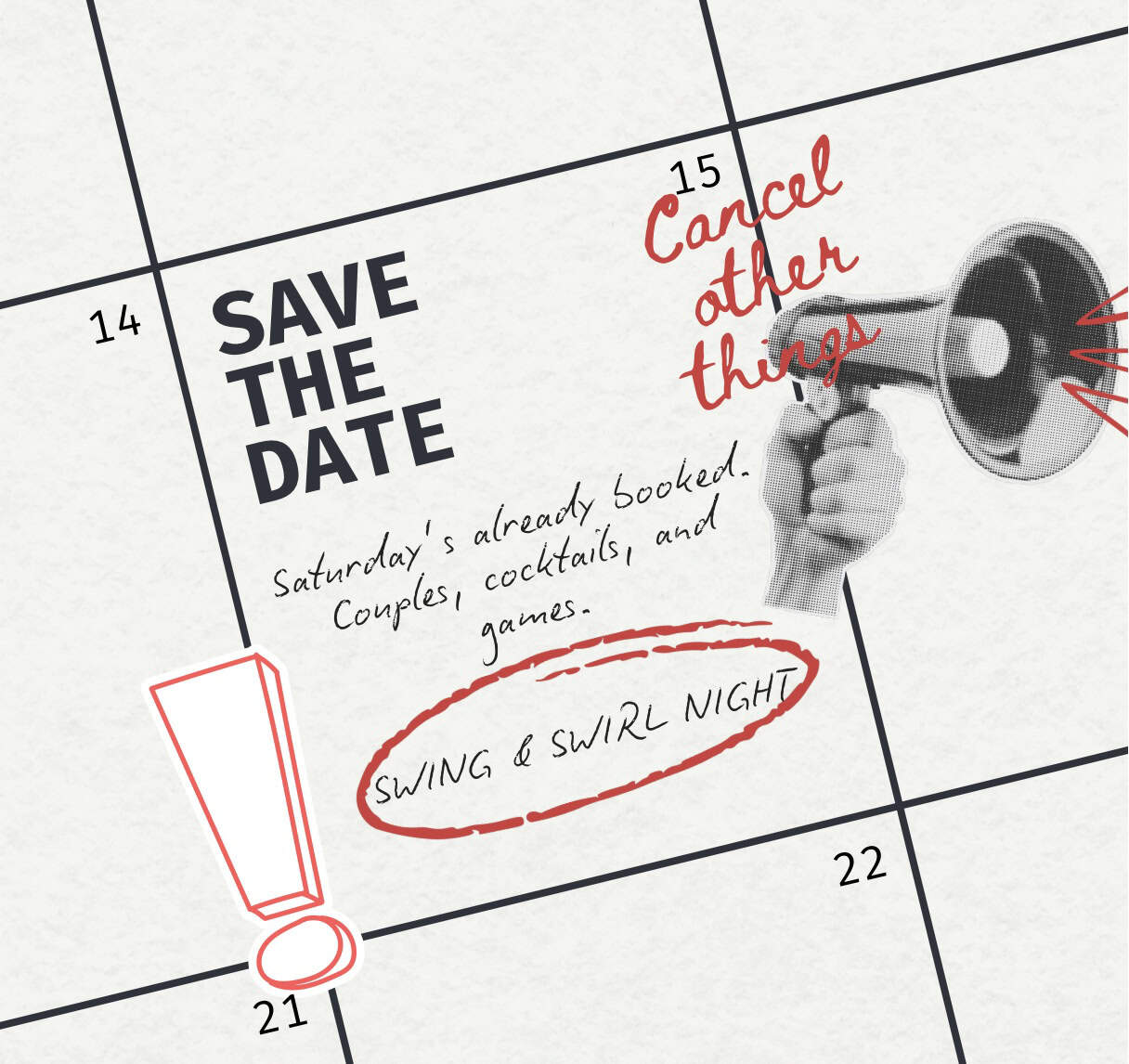
And If you thought open marraiges was a taboo I have a breakthrough here. Those light-switch “swap your partner” games which were once porn plotlines? Turns out, they’re Saturday nights in suburbia. Secret parties, partner mix-and-match like it’s speed dating with IKEA returns.
India’s dating scene has already RSVP’d. A 2024 survey found 41% of Indian millennials and Gen Z would say yes to an open relationship if their partner asked, and 35% admit they’re either in one or curious about it.
Therapists are reporting more couples coming in with ethical non-monogamy often as a last-ditch alternative to divorce. Meanwhile in the U.S., peer-reviewed data shows 3–7% of adults are already practicing consensual non-monogamy.
Searches for ‘open relationships in India’ are climbing each year, reflecting this cultural shift.
Society claps for it. Italians call it chic, Netflix calls it content, TikTok calls it progressive. Meanwhile, it’s the same story, couples too exhausted to build intimacy by slapping “open” on the label so they don’t have to admit they’ve given up.
For some, ‘we’re open’ reads less like freedom and more like a truce they don’t want to name. And here is a kicker. People are calling this “the future of love”—consensual non-monogamy. No, darling, it’s the future of marketing. It’s not “liberating.” It’s outsourcing.
I’m sorry, but what? Since when did ‘I love you’ arrive with a plus-one on the calendar? Well then, is that possible if people are in an “open marriage,” are not at all in love? They’re in logistics?
Of course, they can care for each other, they can be addicted to each other’s presence, they can have habits and history but love? Love doesn’t share toothbrushes or bedposts. Love doesn’t politely schedule its turn on the calendar.
The pros and cons of open relationships get debated endlessly but what we often see is not freedom, it’s convenience. What we’re really talking about is the modern roommate arrangement: the long-term live-in partner who covers half the bills, keeps the bathroom stocked, and plays “family” at holidays. And then, for sexual dessert? They go browsing outside. Convenience, not connection. Stability with a side of strangers.
If “liberation” looks like a long-term roommate with benefits and outsourced orgasms — that’s not love, babe. That’s a franchise. People are turning cowardice into philosophy. Mistaking boredom for a manifesto and parading it online like they invented a new religion.
Ghost #3: The Instagram Ideal — Auditioning for Strangers

There is a requirement for an “ideal partner”? Outrageous.
A lover isn’t enough anymore. They have to be a therapist, a travel agent, a surprise-party planner, a motivational speaker, and a full-time influencer partner. (That’s not a relationship — that’s an unpaid staff of five wearing one face.)
The absurd ideal starts here: modern relationships on Instagram aren’t intimate anymore, they’re curated content. That’s usually when you start feeling the shift — not breakups yet, just that eerie ‘something’s off’ hum. I wrote about that in detail [here].
Social media didn’t just raise the bar, it launched relationship expectations into the stratosphere. Quiet gestures are dismissed; grand spectacles are fetishized. Surprise trips, elaborate proposals, anniversary flash mobs — all documented for people who will scroll past in 1.5 seconds. And the cruelty? What was once extraordinary is now the baseline.
A spontaneous trip to Paris? Cute, but where’s the yacht?
A heartfelt anniversary post? Nice, but why isn’t it viral?
The algorithm isn’t impressed by devotion. It wants viral drama, luxury weddings, and Instagrammable absurdity.
We stage luxury ceremonies like runway shows — couture gowns, drone footage, vows read under chandeliers. But behind the scenes, the real backbone isn’t lace or love. It’s intimacy on a calendar invite, affection on retainer.
They’re not feeling passion; they’re planning content. They’re fighting about whose turn it is to edit the video. The love story looks pristine on the grid, but inside the house it’s often held together by duct tape and silence. It’s an audition. It’s rehearsals.
And one day, when the cameras are gone, all that will be left is two people wondering if they ever actually loved each other — or if they just loved the applause.
We’ve all seen the influencer divorce announcement, the “we grew apart” Notes app apology, the joint video where two people can’t even look each other in the eye. We clap for curated love, then act shocked when it crumbles. But what did we expect? You can’t build intimacy for an audience. You can only perform it.
And yet, we keep buying the illusion. We scroll, we compare, we envy. We measure our own private relationships against the highlight reels of strangers. “Why doesn’t he do that for me?” “Why doesn’t she look that happy?” “Why don’t we have what they have?” Forgetting, of course, that what they have is an influencer brand, not a love story.
And here’s the data clapping in the background: a 2024 survey found that in India, nearly 70% of young daters admit social media harms relationships and complicates intimacy, with many confessing they measure closeness by online proof. Globally, multiple studies confirm the same circus. Heavy instagram use predicts higher jealousy, comparison, and lower relationship satisfaction. In other words: the more you scroll, the more you sabotage your own love story.
So my question: If your relationship depends on strangers’ approval to feel real, is it intimacy at all — or just performance?
Ghost #4: Vows in Fine Print — Love as Legalese. When Intimacy Gets KPI’d

Once upon a time, vows were poetry. “For better or worse, for richer or poorer, in sickness and in health.” Now they sound more like “see clause 12, subsection B.”
We don’t say “I do” anymore; we say “see terms below.” Marriage has become less about promises and more about paperwork and relationship contracts. Prenups, postnups, cohabitation agreements, even pet-custody clauses (yes, the dog now has a lawyer). It’s no longer “till death do us part” but “until a notary intervenes.” Response-time rules, date quotas, ‘minimum intimacy’ targets—love as a deliverable. Affection as a KPI. Passion as a performance review. This modern love isn’t commitment. It’s insurance. A romance rehearsing its obituary while the ink on the vows is still wet.
Prenups are laughable when you step back not because they’re impractical, but because they assume from day one that the love is on a timer. That the end is coming, and the lawyers should be ready with champagne flutes. Fear of gold-diggers. Fear of alimony. Fear of being used. It’s less about who you love, more about what they might cost you later.
Prenups spark debate in India while gaining visibility elsewhere either way, we’re negotiating love with paperwork. The wealthy have gotten creative. They now using family trusts and asset-protection agreements as prenup substitutes turning “I do” into a ledger entry before the mehendi has even dried.
Meanwhile in the U.S., the shift is undeniable. Surveys show Among younger cohorts, prenups feel less taboo and more practical which is another sign that romance now shares space with risk management compared to older generations who saw it as a red flag.
Axios even called prenups the new love language of Gen Z. Translation? Forever is now written in legalese. Pop culture doesn’t help. A billionaire drafting a sex contract for his lover and somehow decided it was aspirational. Fantasy blurred into “normal,” and suddenly young women are told it’s sexy to sign their boundaries away in a document. Scroll TikTok and you’ll see viral relationship contracts and love checklists that look more like HR paperwork than love letters.
And let’s be clear, this isn’t just a bash. It’s a doomsday scenario dressed in couture. Where’s trust in all of this? Isn’t trust supposed to be one of the pillars of love? If someone truly trusts their partner, why are they drafting clauses for every “what if”? Even if there’s a 0.1% chance written into that prenup, it’s still a declaration of distrust. A contract doesn’t say “I believe in your character”; it says “I don’t trust it.”
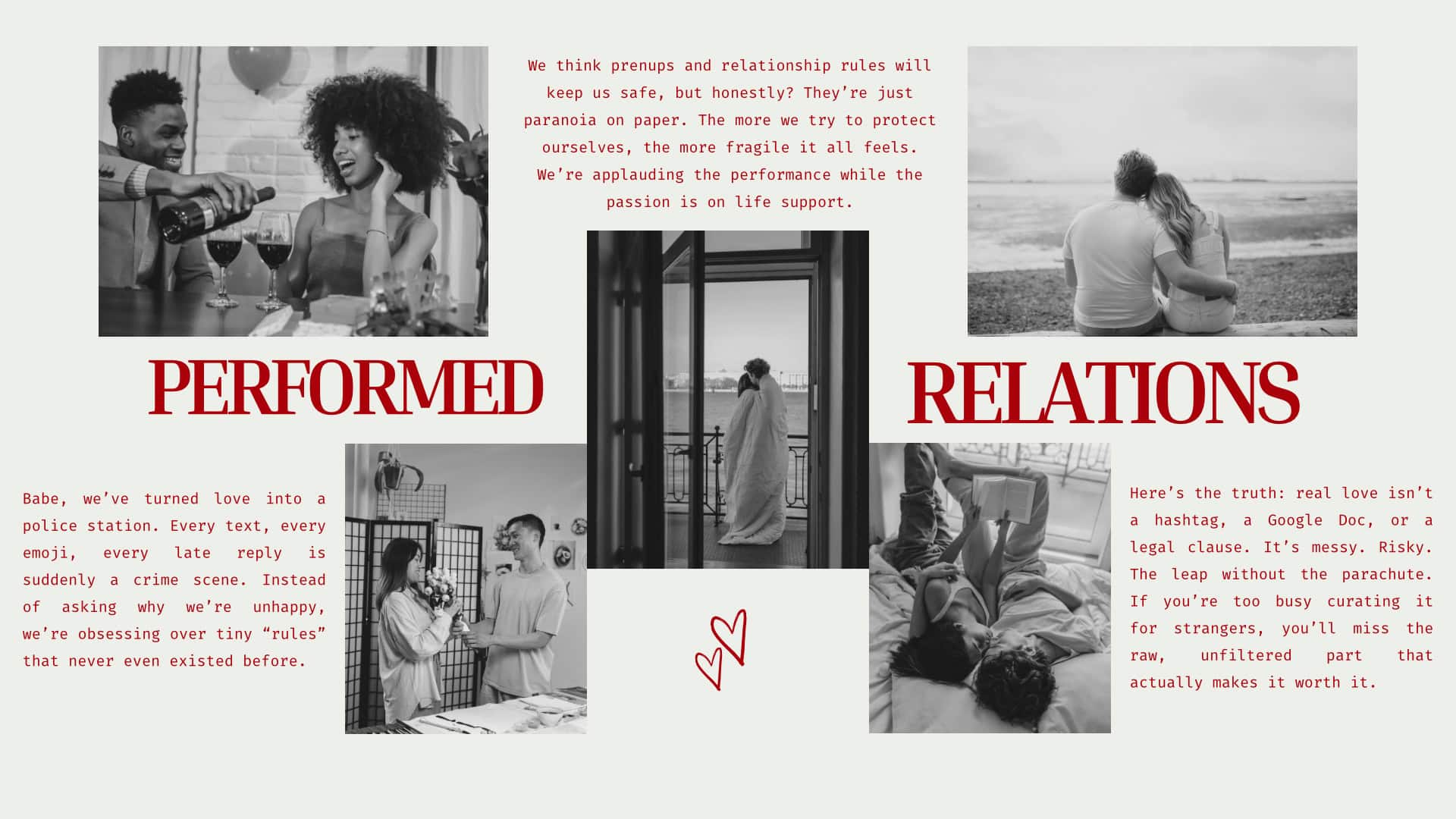
People defend it by saying, “you shouldn’t trust anyone blindly.” But isn’t that the point of love? Blindness. Leap, not caution. The jump without the parachute. Somewhere along the way, we stopped leaping and started lawyering.
Underneath it all, the big question: if someone is already planning for collapse with prenups or contracts, are they really building for forever? Or just managing the countdown?
Clinking Glasses With Ghosts
So here we are. Four ghosts, four costumes, four performances.
The ideal has turned private passion into rehearsals for strangers. What used to be private is packaged. What used to be sacred is scheduled. What was once whispered in dark corners is now filmed, hashtagged, and uploaded before the sheets are even cold.
This is the house modern love built — a haunted one.
And it feels like people are more afraid than ever. Afraid of betrayal, afraid of loneliness, afraid of not measuring up. I’m not even sure if today’s rules are preventing cheating or simply multiplying insecurities. The more obsessively we police the boundaries of modern relationships, the less we actually ask the core question: why do people cheat? Not the hashtags. Not the scandal. Not the TikTok exposés — the why.
And that’s the piece most of us skip — the why. If you want to see the unspoken machinery pulling the strings, I went there [here].
Contracts promise stability, but they breed paranoia. Intimacy shrivels when it becomes an obligation. You can legislate chores, bills, custody rights. But you cannot legislate intimacy or desire. You can protect the house, but not the pulse. You can notarize assets, but not orgasms. Try KPI-ing a kiss and watch it wither on the page.
The safety net doesn’t even feel safe. By drafting contracts for every possible failure, couples manifest the very doomsday they’re trying to avoid. It’s like buying a fire extinguisher and then lighting the curtains on purpose, just to prove you needed one.
Marriage isn’t about protecting a partner anymore — it’s about protecting yourself from them. People don’t marry with forever in mind; they marry with alimony in mind. Wealthy couples expect to be sued by the very person they swore to love. And instead of asking “Can I trust myself to choose the right person?” they skip straight to “Let’s prepare for disaster.”
This is the ghost that exhausts me the most. Social media has convinced us that a relationship doesn’t exist unless it’s posted, filtered, and hashtagged. If it isn’t posted, it didn’t happen. Proof has replaced presence. We’ve outsourced our definition of intimacy to Instagram polls and TikTok trends, auditioning for strangers’ approval instead of actually being in love.

It’s a show for the outside world. A happy-family façade is staged for Instagram feeds and Christmas cards, while inside the house the couple is scheduling appointments just to speak to each other.
Loneliness inside the relationship. Desire starved at home. The thrill of novelty strangled by routine. It’s in these quiet suffocations where the symptoms show up first — the subtle signs I unpacked [here]. But instead of fixing that, we’ve turned betrayal into entertainment and paranoia into rulebooks. We clap for it. We double-tap it. We call it progress.
But if this circus keeps calling itself romance, what’s left of love except the costume? Because real love isn’t a hashtag, a clause, or a content strategy. It’s not proof for strangers. It’s not insurance against heartbreak. It’s not a contract written in legalese.
It’s a leap. A fever. A madness that risks the fall without a parachute.
And maybe that’s what scares us most: we’ve grown too cautious, too curated, too managed to risk the rawness of love. So instead, we dress the ghosts in couture — and call it normal.