
The Ghosts No One Warns You About When a Relationship Feels Off
These are words I’ve never said out loud partly because I didn’t know how, partly because who wants to be that girl? When a relationship feels off, I always assume it is my fault. Because how do you explain being unhappy in a relationship that looks flawless on paper? How do you point fingers when there’s no visible crack, no lipstick smudge of evidence?
So I stayed quiet. Because saying it out loud meant I’d have to explain it. And couldn’t. I wondered if I was broken. Too hungry. Too much. Maybe this is what people mean when they say “be content”. Maybe the ache was mine to swallow. But the truth kept slipping back in, sharp as glass: good isn’t always enough.
And that’s the part I hate admitting the most. Who looks at good love and still aches for something more? Someone selfish? Ungrateful? Someone who deserves to be alone? Maybe. Or maybe someone honest. (Or maybe just someone who refuses to settle for a love that feels like tuesday leftovers reheated again and again.)
Here’s the thing nobody tells you. The hardest heartbreak isn’t cinematic kind. It’s not slammed doors, betrayals, or the dramatic exits ripped straight from Netflix dramas. It’s quieter. The slow suffocation of being in a good relationship that doesn’t actually feel good enough.
Psychologists even have a name for it, “ambivalent relationships”. These are the ones that look picture-perfect but secretly drain you. Research shows they can be just as harmful to mental health as openly toxic ones (Psychology Today).
It’s the kind of ache that hides between pasta dinners, morning routines, and “How was your day?” texts.
I felt like an extra in my own life. Smiling on cue. Playing fulfilled while a restless part of me screamed behind the curtain. (Think Broadway actress, but without the standing ovation at the end.)
You know, the cruelest part is the invisible ache makes you feel guilty for wanting more, even when you can’t define what more is. So it stays nameless. Because how do you label something that doesn’t technically exist? Where silence becomes the third person in the room.
But the whispers never left. That’s why I decided to name it. Not because naming fixes it, but because sometimes dragging a ghost into the light is the only way it stops feeling like a monster.
If you have ever heard those whispers too, darling your’re exactly who CHIC GEEK writes for.
Let me ask you something and be brutally honest with yourself.
Have you ever sat across from someone who’s practically perfect on pape and still felt… nothing?
Have you ever said “thank you” so many times it started to sound like a line from a badly written script?
Have you ever laid in bed at night whispering to yourself, “Am I broken? Am I selfish? Why can’t I just be happy with what I have?
Have you ever stayed in a relationship not out of love, but out of fear of being a villian?
Have you ever caught yourself imagining another life and then hated yourself for betraying the one you’re in?
Have you ever sat in a perfectly calm room with someone you love and felt your chest tighten like you couldn’t breathe?
Have you ever told yourself, “This is just stability, this is adulthood”, while secretly yawning at your own life?
Have you ever looked at the person you love and realized you’re running ahead while they’re still standing still?
And here’s the one nobody says out loud.
Have you ever secretly wished they’d mess up in some massive, dramatic way — just so you could leave without being the villain?
If you nodded yes—even once—you already know. This ache doesn’t storm in with betrayal or fireworks. It whispers. It’s the ghosts in the attic — the kind people are too afraid to drag into the light, but too exhausted to keep living with.
 “If this hit you in the gut. You are not alone. Tell me your stories. Join the Chic Geek list — no sugar-coating.”
Goodness Guilt
Goodness Guilt is what happens when “good enough” quietly turns into a trap.
On the outside, everything looks perfect. The partner who is kind, dependable and present. The kind of stuff rom-com checklists are made of. But inside? It feels flat. Numb. Sometimes even hollow. It presses on you in two ways:
First, it silences you. Because how do you explain being unhappy in a relationship that ticks all the boxes on paper but feels empty on the inside? How do you say “I don’t feel it” when there’s nothing “wrong” to point to?

Second, it turns the blame inward. You start calling yourself selfish. Ungrateful. Maybe even broken. Speaking it out loud feels like honesty and more like confessing to a crime.
It is loop of guild complex where shame convinces you you’re impossible to please or undeserving of more. Basically, the mental version of ‘it’s not you, it’s me’ — but directed at yourself, on repeat.
The worst part is, there’s no evidence. No betrayal. No chaos. No scandalous text receipts. Which leaves only one culprit — you. You convince yourself you’re impossible to please, greedy for more, undeserving of love.
And that shame? That is what keeps you silent. It isn’t loud. It isn’t messy. It’s just heavy.
That’s the weight of the Goodness Guilt. It doesn’t just make you question your relationships; it makes you question yourself. It convinces you that you’re the villain for wanting something you can’t even name.
And nostalgia doesn’t help. If anything, it sharpens the ache. You remember the midnight jokes that left you gasping for air, the texts that made your stomach flip, the way holding hands once felt like magic. Back then, even the boring stuff sparkled. And now you wonder: If it was real once, why can’t I touch it anymore?
Gratitude Trap
If Goodness Guilt is the first ghost, then the Gratitude Trap is its shadow. Same ache, different mask. Goodness Guilt makes you feel like a villain for wanting more. Gratitude Trap punishes you for even daring to imagine it.
People rarely admit it out loud. Instead, they lower their voices, backspace their words, circle the truth like it’s radioactive.
They confess in fragments:“He’s so good to me… I feel horrible even saying this, but I don’t feel it anymore” Or“I know I should be grateful. I have what everyone else dreams of. So why does it feel like I’m suffocating?”
That’s the Gratitude Trap. It doesn’t announce itself with fights or betrayals. It hides in polite apologies for your own emptiness. In “thank yous” that don’t taste like gratitude but more like repayment on a debt.
From the outside, the trap looks virtuous. You look blessed, content, enviable even. Nobody suspects you’re choking under velvet chains. Because it doesn’t strangle loudly. It presses in quietly, until even joy feels borrowed.
And here’s the twist: the longer you’re inside, the less you question the relationship. Instead, you interrogate yourself. That’s the true cruelty of Gratitude Trap — it convinces you that wanting freedom makes you disloyal. That leaving isn’t honesty. It’s betrayal.
This is just toxic gratitude — when obligation and guilt warp your ability to feel joy, tricking you into staying stuck.
What-if Syndrome
Some ghosts don’t break the door down. They slip in quietly, like a draft under it. A whisper:“What if there’s something more?”
The What-If doesn’t shout. It doesn’t accuse. It lingers. And once you hear it, you can’t un-hear it.

You don’t say it out loud, of course. You scold yourself instead — call it greedy, disloyal, impossible to satisfy. But the whisper doesn’t flinch. It shows up anyway: on long drives with the radio low, in the shower at 2 a.m. when you should be asleep.
But here’s the cruelest part: the whisper isn’t tempting you with another person. It isn’t about a name or a face. It’s about you. The version of yourself you might have been. The life unlived. The roads less travelled.
That’s what keeps you awake — the thought that maybe you’re missing out on your own story while performing someone else’s script.
Once upon a time, the what ifs were sweet. “What if we move in? What if we get a dog? What if we grow old together?” Back then, questions expanded the love.
Now, the same words feel like evidence. Proof that a part of you is already slipping away. And fear of missing out (FOMO). It’s not always about parties or instagram scrolls; it can creep into intimate spaces too, leaving people restless in relationships that “should” feel secure.
ABOUT ME

This is a story stitched between contrast—where quiet minds meet loud wardrobes, and depth doesn’t shy away from shine. Chic Geek was born from the spaces in-between: between mirrors and meaning, beauty and becoming. Here, fashion isn’t just fabric, and routines aren’t just rituals—they’re reflections.
Chic Geek
Boredom in Disguise
Boredom is clever. It rarely introduces itself as boredom. Instead, it dresses up as maturity, as stability, as “this is what long-term love is supposed to look like”. And for a while, you nod along. You convince yourself this is what “growing together” feels like.
But then the cracks begin to show. Days blur into reruns of a show you once adored but now half-watch on autopilot. Conversations loop. Routines drag. The spark fades into background noise. And then the truth lands heavy: you’re not grounded — you’re stuck.
One day you notice you’re not losing sleep anymore. The late-night talks that once peeled back layers now feel like recycled scripts.
Back then, every moment felt like a discovery. Now? Predictable. And instead of safe, you feel invisible — even to yourself. The trickiest layer is not just the monotony. It’s the shame.
Boredom is the most unsexy villain in the love story. People will admit to fighting, cheating, jealousy because at least those sound cinematic. But boredom? That’s harder. It makes you sound like you’re the problem.
To say out loud “I love you, but I’m yawning inside this life we built” brands you the unstable one. The ungrateful one.
Psychologists call this type of emotional dulling “hedonic adaptations” — our tendency to acclimatize to what once thrilled us, slowly making even love feel like background music. Verywell Mind mentioned this adaptation means excitement fades, and constant novelty becomes the only way to feel alive again.
And boredom doesn’t arrive in one dramatic wave. It sneaks in slowly — the way silence fills a room after laughter fades. You swallow it. You smile. You play along, And that’s the tragedy: you’re living a love story that looks alive, but feels already over.
Mirror Exhaustion

Have you ever woken up and realized you can’t remember the last time you made a decision just for yourself?
Suddenly everything is we. What we eat, what we watch, what we want. At first, that kind of closeness feels romantic—the stuff of fairytales and Instagram captions. But then, one day, you catch yourself craving space. Just one evening alone, one breath that doesn’t belong to both of us. And the second you do, guilt slams down like a verdict.
That’s the first sign your relationship isn’t tender anymore — it’s suffocating. You stop doing things together because you want to and start doing them because you should.
Psychologists have even coined a term for this: enmeshment — when boundaries blur so much that your sense of self slowly erodes inside the relationship and how it can cause anxiety, guilt, and loss of individuality.
What you’re feeling isn’t boredom. It’s emotional claustrophobia. You don’t feel abandoned; you feel crowded. Not lonely, but like your individuality is dissolving into us.
The little things you once adored — the constant hand-holding, the check-in texts, the endless “where are you?” updates — now land like weight. They don’t feel loving anymore; they feel like pressure.
And it spreads. You catch yourself rolling your eyes at tiny things that never mattered before. The way they chew, the way they hover. The way their presence seems to take up all the oxygen in the room.
Because the truth is love without air isn’t closeness. It’s a cage lined with affection.
Third Presence
There are two silences in a relationship.
The first is tender — the kind where you don’t have to fill every pause. It’s easy, comfortable, proof that love can breathe without noise.
And then there’s the second. The one that doesn’t soothe but sits between you like an uninvited guest.
Heavy. Watching. Saying everything you won’t.
It doesn’t crash in suddenly. It creeps. First, you stop sharing the small things — the throwaway jokes, the stray thoughts. Then, little by little, even bigger things. And before you notice, words stop crossing the table. You’re no longer sitting across from your person. You’re sitting across from the silence itself.
The ache here isn’t the quiet; it’s how loud that quiet becomes. You hear it in the way your phone glows brighter than your face at dinner. In the way your eyes glance down instead of meeting. Silence doesn’t just fill the room. It becomes the room.
Do you remember when silence was rare? When you stayed up all night talking about everything and nothing? Now it feels like a ghost louder than either of your voices. It haunts even the moments that should feel warm.
That’s the Third Presence. Not shouted. Not spoken. Just deafening.
Psychologists call this the demand–withdraw cycle, where one partner pulls back and the other retreats further — until silence becomes the relationship’s loudest voice. According to the Gottman Institute, this pattern is one of the strongest predictors of relationship breakdown.
And maybe what is cruel is when love dies, it doesn’t always end in storms or slammed doors. Sometimes, it ends in nothing at all. Just a silence taht swallows everything whole.
Asymmetry Ache
Not every love story ends with betrayal. Some end with pacing. One of you sprints, the other strolls. One grows hungry for change, the other finds comfort in stillness. Neither is wrong. But together, the rhythm falters.
At first, it’s subtle. You notice it in the small ways. The books you’re devouring don’t spark the same conversations. The dreams you’re chasing feel like solo missions. Even your arguments tilt off-balance — one pushing forward, the other digging in.
Then it hits you: you’re not walking the same road anymore. Just overlapping paths that don’t quite align.
The ache here isn’t rage. It’s loneliness.

The kind that sneaks in when you’re lying next to someone still physically there but no longer traveling with you emotionally. You glance over, and the distance isn’t measured in miles it’s measured in speed.
And the cruelest trick? You make yourself more miserable by replaying the good old days. Back when you ran side by side, reckless and in sync, daring each other to dream bigger. Everything felt aligned. Until one day, you looked around and realised: somewhere along the way, you started running alone.
Now, it feels like you’re drifting apart in inches that turn into miles. Every step becomes heavier. Every silence becomes sharper. Until the space between you is no longer bridgeable.
When your emotional energy, dreams, or pace no longer align. According to Psychology Today’s “Relationship Rhythms,” these “out-of-sync” styles often explain why partners feel like they’re drifting apart even when nothing externally seems broken.
That’s the Asymmetry Ache. Not cruel. Not loud. Just drifting.
The Ache That Names Itself
So there they are — the ghosts.
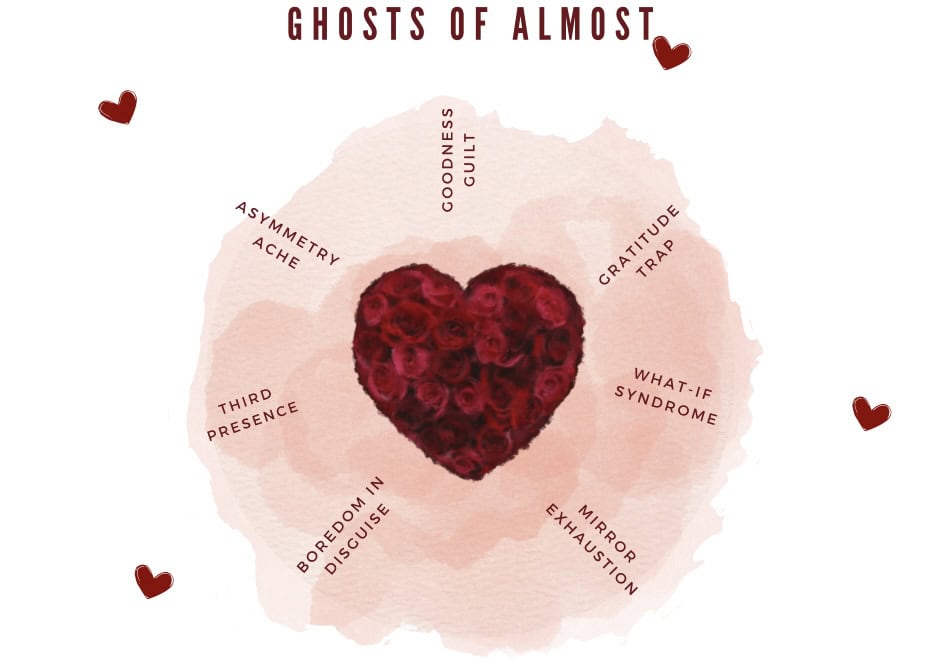
The Goodness Guilt. The Gratitude Trap. The What-If Whisper. Comfort That Suffocates. Boredom in Disguise. The Third Presence. The Asymmetry Ache.
Maybe you recognized one. Maybe you saw yourself in all seven. If so, don’t panic. You’re not cursed. You’re human.
These aren’t the signs of being broken; they’re the quiet symptoms of something most people never name. That’s why they feel so haunting because they rarely make it into words.
But here’s the power in naming them: it doesn’t banish the ghosts, but it proves you’re not imagining them. It gives language to what was once only guilt, or shame, or silence.”
Research shows how naming emotions helps regulate them from the American Psychological Association. Suddenly the ache isn’t a blur. It becomes something you can point to and say, “This. This is what I’ve been feeling”.
Still, naming is only the first step. Because once you know they’re there, a harder question follows: why? Why do good relationships grow hollow? Why does gratitude harden into chains? Why does silence gain a voice louder than love?
That’s where the story continues.
In the next chapter, I have pulled up the floorboards — not just the symptoms, but the mechanics beneath them. The messy, unorthodox psychology. The taboo truths nobody puts in the rom-coms or relationship guides.
This blog is the diagnosis. But names aren’t everything. To understand why these ghosts show up, you have to dig deeper. And that iss exactly where we are going next. Click for the reason why!?
If you recognized even one of these ghosts, you’re not cursed — you’re just human. But don’t keep them in the attic. Let’s drag them into the light together. You belong in the Chic Geek Circle, and I’ll send you more whispers, more truths, no sugar-coating. Stay in the loop, stay in the light.







EMOTIONS
